PC filament, ranked by £/kg
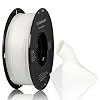
Polycarbonate is the high-temperature, high-impact option. It demands a hot end well above 260°C, an enclosure, and thorough drying.




Guides
-
Bed adhesion: what actually works
Glue sticks, hairspray, rafts, brims and expensive surfaces — an honest ranking of what fixes prints coming loose, starting with the free fix that solves most cases.
-
Do you need a filament dryer?
Wet filament is real and ruins prints, but a dedicated dryer is not the only answer. How to tell if moisture is your problem, and what to do about it.
-
Filament storage: dry boxes, vacuum bags and desiccant
Keeping filament dry is cheaper than drying it out. What actually works, what desiccant to use, and why the little sachet in the bag is already spent.
-
First layer calibration, properly
Nearly every adhesion problem and half of all print failures start in the first layer. How to set Z offset by eye, and what a good first layer actually looks like.
The high-temperature option
Polycarbonate is the strongest and most heat-resistant material in common desktop use. It stays usable well above 110 °C, has outstanding impact resistance — it is the material used for riot shields and machine guards — and can be optically clear in thin sections.
It is also the hardest of these materials to print, and it is not a reasonable first experiment.
What it demands
- A hot end that genuinely reaches 260–300 °C. A hotend with a PTFE liner is not suitable — PTFE degrades above roughly 240 °C. You need all-metal. See PTFE tubing.
- An enclosure. PC warps aggressively and delaminates in a draught.
- Thorough drying. PC is very hygroscopic, and wet PC prints as a bubbled, weak mess. Dry it before every use.
- A high bed temperature, typically 100–120 °C, plus an adhesive.
Settings to start from
Nozzle 260–300 °C, bed 100–120 °C, cooling off, enclosure closed and warm. Slow down, and use a brim on anything with a footprint.
Be honest about whether you need it
Most parts that people reach for PC to make would be perfectly well served by PETG or ASA at a fraction of the difficulty and cost. PC earns its place when a part must survive genuine heat and impact together — and if it does not, the material will simply make your life harder for no benefit.
Buying notes
PC is among the most expensive filaments here and there is wide variation between blends. Many products sold as polycarbonate are PC alloys (PC-ABS, PC-PBT) formulated to be more printable, with slightly lower temperature resistance — often the more sensible purchase. Read the listing carefully; the £/kg figure alone will not tell you which you are getting.
How to read this table
The per-kilo column is the only number that compares listings honestly. A spool sold at 40% off can still be poor value, and a multi-spool bundle looks expensive until you divide by its total weight. We count bundles at their full weight, so a 4 × 1 kg pack and a single 1 kg spool sit on the same scale.
Where a listing does not state a usable weight we leave the per-kilo figure blank rather than guessing — a wrong ranking is worse than a missing one.