PETG-CF filament, ranked by £/kg
Carbon-fibre-filled PETG is stiffer and more dimensionally stable than plain PETG, with a matte finish. The fibres are abrasive, so a hardened nozzle is required.
| Product | Material | Weight | Rating | Price | Per kg | Deal |
|---|---|---|---|---|---|---|
 TINMORRY Glass Fiber PETG Filament 1.75mm, High Impact Resistance PETG GF 3D P |
PETG-CF | 1 kg | 4.7 out of 5 (4 Amazon ratings) | £45.38 | £45.38 | — |
 TINMORRY Carbon Fiber PETG Filament 1.75, PETG CF 3D Printer Filament, Compati |
PETG-CF | 1 kg | — | £45.82 | £45.82 | — |
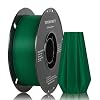 TINMORRY Glass Fiber PETG Filament 1.75mm, High Impact Resistance PETG GF 3D P |
PETG-CF | 1 kg | 3.8 out of 5 (4 Amazon ratings) | £46.71 | £46.71 | — |
 The Filament - Filament PETG CF 1.75 mm, grey, 1 kg spool, 3D printer printing |
PETG-CF | 1 kg | 5.0 out of 5 (1 Amazon ratings) | £66.46 | £66.46 | 6% below |
Guides
-
Bed adhesion: what actually works
Glue sticks, hairspray, rafts, brims and expensive surfaces — an honest ranking of what fixes prints coming loose, starting with the free fix that solves most cases.
-
Do you need a filament dryer?
Wet filament is real and ruins prints, but a dedicated dryer is not the only answer. How to tell if moisture is your problem, and what to do about it.
-
Filament storage: dry boxes, vacuum bags and desiccant
Keeping filament dry is cheaper than drying it out. What actually works, what desiccant to use, and why the little sachet in the bag is already spent.
-
First layer calibration, properly
Nearly every adhesion problem and half of all print failures start in the first layer. How to set Z offset by eye, and what a good first layer actually looks like.
Stiffer, matte, dimensionally stable
Carbon-fibre-filled PETG takes an already useful engineering filament and adds short chopped fibres. The result is significantly stiffer, more dimensionally stable, and far less prone to stringing than plain PETG — the fibres change how the melt behaves, and many people find CF grades easier to print than the unfilled version.
It also comes out with a deep matte, slightly speckled finish that hides layer lines well. For functional parts that will be seen, that is a genuine benefit.
What you give up
Carbon fibre makes parts stiffer, not stronger in every sense: filled filaments are generally more brittle and have lower impact resistance than the unfilled polymer. If a part needs to flex or absorb a knock, plain PETG is the better choice. If it needs to hold its shape under load, CF wins.
You need a hardened nozzle
This is not optional and it is the main hidden cost. Chopped carbon fibre wears brass quickly — sometimes within a single spool. The failure is gradual: the orifice widens, extrusion width drifts, and print quality declines in a way that looks like a calibration problem. Fit hardened steel and leave it there. See hardened versus brass nozzles.
A wider nozzle also helps — 0.4 mm works, but 0.6 mm clogs less. See nozzle sizes explained.
Settings to start from
Nozzle 240–260 °C (usually a little hotter than plain PETG), bed 70–85 °C, cooling moderate. Dry it first: CF grades are just as hygroscopic as the PETG underneath.
Buying notes
Expect a clear premium over plain PETG. Fibre content varies between brands and is rarely stated precisely, so results differ more than the label suggests — if one brand works well for you, stay with it.
How to read this table
The per-kilo column is the only number that compares listings honestly. A spool sold at 40% off can still be poor value, and a multi-spool bundle looks expensive until you divide by its total weight. We count bundles at their full weight, so a 4 × 1 kg pack and a single 1 kg spool sit on the same scale.
Where a listing does not state a usable weight we leave the per-kilo figure blank rather than guessing — a wrong ranking is worse than a missing one.