TPU filament, ranked by £/kg
TPU is flexible. Shore hardness matters more than brand: 95A is the common general-purpose grade, lower numbers are softer. Direct-drive extruders handle it far better than Bowden.
| Product | Material | Weight | Rating | Price | Per kg | Deal |
|---|---|---|---|---|---|---|
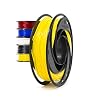 Gizmo Dorks Flexible TPU 3D Printer Filament 3mm (2.85mm) 200g, Yellow |
TPU | 0.2 kg | 4.0 out of 5 (164 Amazon ratings) | £24.09 | £120.45 | — |
 SainSmart Small Spool 1.75 mm TPU Flexible 3D Filament 250 g, Dimensional Accu |
TPU | 0.25 kg | 4.6 out of 5 (2,171 Amazon ratings) | £30.19 | £120.76 | — |
 Gizmo Dorks Flexible TPU 3D Printer Filament 1.75mm 200g, Black |
TPU | 0.2 kg | 4.5 out of 5 (741 Amazon ratings) | £25.28 | £126.40 | — |
 3D Printer Filament 3D Printing Filament TPU Flexible Elastic net Weight 1000g |
TPU | 1 kg | — | £132.46 | £132.46 | — |
 NinjaFlex TPU - 1.75mm - 1 kg - Sapphire Blue |
TPU | 1 kg | 4.3 out of 5 (103 Amazon ratings) | £149.56 | £149.56 | — |
 NinjaFlex TPU - 2.85mm - 0.5 kg - Lava |
TPU | 0.5 kg | 3.9 out of 5 (39 Amazon ratings) | £79.53 | £159.06 | — |
 NinjaFlex TPU - 1.75mm - 1 kg - Snow White |
TPU | 1 kg | 4.3 out of 5 (103 Amazon ratings) | £182.04 | £182.04 | — |
Guides
-
Bed adhesion: what actually works
Glue sticks, hairspray, rafts, brims and expensive surfaces — an honest ranking of what fixes prints coming loose, starting with the free fix that solves most cases.
-
Do you need a filament dryer?
Wet filament is real and ruins prints, but a dedicated dryer is not the only answer. How to tell if moisture is your problem, and what to do about it.
-
Filament storage: dry boxes, vacuum bags and desiccant
Keeping filament dry is cheaper than drying it out. What actually works, what desiccant to use, and why the little sachet in the bag is already spent.
-
First layer calibration, properly
Nearly every adhesion problem and half of all print failures start in the first layer. How to set Z offset by eye, and what a good first layer actually looks like.
The flexible one
TPU makes anything that needs to squash, grip or absorb a shock: phone cases, gaskets, feet, tool grips, drive belts, protective bumpers. It is also abrasion-resistant and surprisingly tough — a TPU part will usually survive being run over, which is not true of anything else on this site.
Shore hardness is the number to check
TPU is sold by hardness on the Shore A scale. 95A is the general-purpose grade: firm, like a shoe sole, and by far the easiest to print. 85–90A is noticeably softer and harder to feed. Below 85A is genuinely difficult on most consumer machines.
If a listing does not state a Shore rating at all, treat that as a small warning about how carefully it has been specified.
Your extruder decides whether this works
A direct-drive extruder grips the filament immediately above the nozzle, so soft filament has almost no distance in which to buckle. A Bowden setup pushes it down a long tube where it compresses like a spring, giving inconsistent extrusion and blobbing. Bowden machines can manage 95A with patience; softer grades are a project rather than a print.
Full detail in printing with TPU.
Settings to start from
Nozzle 220–235 °C, bed 40–60 °C, speed 15–25 mm/s, and retraction near zero. Slowing down fixes more TPU problems than any other single change.
No enclosure is needed and a standard brass nozzle is fine — TPU is not abrasive. A 0.4 mm nozzle works, but 0.6 mm feeds soft filament more willingly if you have one. Keep the filament path as short and as straight as you can and make sure the spool turns freely; a stiff spool holder is enough to cause under-extrusion at these speeds. See spool holders.
What TPU is bad at, and what to use instead
TPU is slow, stringy, and poor at bridges, sharp overhangs and fine detail. Supports are unpleasant to remove because the part itself bends away from the scraper. It also creeps under sustained load — a TPU bracket holding weight will slowly deform — and it is not a structural material in any sense.
- You want tough, not flexible. That is the usual mix-up. PETG bends before it breaks and prints ten times faster; PLA+ is tougher than standard PLA without changing how you print.
- The part must hold its shape under load. PETG or nylon.
- It needs to be grippy but rigid. Print the body in PETG and add TPU only where it touches — usually a better part than one printed entirely in TPU.
- It needs detail or a clean finish. PLA.
Buying notes
TPU costs noticeably more per kilo than PLA or PETG, and the price range between brands is wide. It also absorbs moisture quickly and prints badly when wet, so buy what you will use and store it sealed with desiccant — see filament storage.
Remember that flexibility comes from geometry as much as material: the same part at 15% and 60% infill feels entirely different. Adjust the model before buying softer filament.
How to read this table
The per-kilo column is the only number that compares listings honestly. A spool sold at 40% off can still be poor value, and a multi-spool bundle looks expensive until you divide by its total weight. We count bundles at their full weight, so a 4 × 1 kg pack and a single 1 kg spool sit on the same scale.
Where a listing does not state a usable weight we leave the per-kilo figure blank rather than guessing — a wrong ranking is worse than a missing one.